Thursday, November 17, 2011

Echo's Fey Child


Maybe my sensual love for the consonne
D’appui, Echo’s fey child is based upon
A feeling of fantastically planned,
Richly rhymed life.

                         I feel I understand
Existence, or at least a minute part
Of my existence, only through my art,
In terms of combinational delight;
And If my private universe scans right,
Which I suspect is an iambic line.
(Canto IV Line: 967-977)

            “Echo’s fey child” is a phrase that holds significance on multiple levels in the novel.  Adjacent to the tale of the relationship between Echo and Narcissus, there is also a myth that depicts Echo conceiving two children with the God Pan.  Echo’s fairy children Iambe and Iynx can be detected throughout the entire texture of the novel.    

            In Greek myth, the nymph Iambe is thought to have comforted the distraught Demeter as she searched for her lost daughter Persephone by performing a dance and telling jokes.  Iambe is the source of the word “iamb” by executing her choreography to time of the iambic meter.  Iamb is a metrical foot in poetry that was originally associated with satirical verse.  Iamb has now evolved into the iambic line that accentuates syllables that form a rhythm that is harmonious to a human heartbeat.  It was a commonly used verse in traditional poetic prose in English writing with artists such as Shakespeare immortalizing the structure of the iambic pentameter.  

            Echo’s other daughter Iynx was metamorphosed into a bird by Hera as punishment for tricking Zeus into falling in love with the nymph Lo.  Iynx was transformed into the Jynx torquilla, commonly called a Eurasian Wryneck that is in woodpecker family.  The bird obtained its name through its capability to rotate its head 180 degrees and its snake like mannerisms of hissing at its enemies.  The characteristics of the Eurasian Wryneck were associated to witchcraft which is a jinx’s current connotation and is also a symbol of restless love. 
            Iambe and Iynx, the two fey children of Echo have dual importance in the development of Pale Fire with each fairy playing a complex role. In Shade’s manifestation of the poem Pale Fire he is capable of channeling his cosmos and processing the universe through the means of iambic verse.  Iambe’s embodiment of satire is also significant in the composition of the novel.   The poem is a sentimental reflection by Shade of the death of his daughter that is further mirrored by the bizarre commentary of Charles Kinbote.  The purpose of this device is to illustrate the facets of death and the afterlife that counters the typical conception of it as an ominous being.  Rather, according to the Orphic Doctrine the transmigration of souls is not perceived as a termination of life but instead is a form of metempsychosis.    The descent to the underworld is painted with “a warm haze of pleasurable anticipation” (219) that allows growth and purification of the soul through reincarnation.  Iynx is also weaved within the fabric of the novel as a complement to the satirical Iambe.  Iynx is manipulated to deceive Pale Fire’s audience by Nabokov cleverly creating a game of worlds that is enveloped with mirrors, mimicry, echoes, and trompe l’oeils that stretch the limits of our concept of reality.  Restless love is a leitmotif that trails hand in hand with Iambe that incorporates a vast dimension of romances.  Nabokov illustrates love between a husband and wife, between a father and daughter, between two “friends”, between two lovers, and between a man and himself.  Through these relationships Echo’s fey children are capable of igniting love and light from the ashes of darkness and death.

            “Whenever I start thinking of my love for a person, I am in the habit of immediately drawing radii from my love-my heart, from the tender nucleus of a personal matter-to monstrously remote points of the universe.  Something impels me to measure the consciousness of my love against such unimaginable and incalculable things as the behavior of nebulae (whose very remoteness seems a form of insanity), thedreadful pitfalls of eternity, the unknowledgeable beyond the unknown, the helplessness, the cold, the sickening involutions and interpenetrations of space and time” (Speak Memory, 296)     

Sunday, November 13, 2011

Life Everlasting-Based On a Misprint!


There’s one misprint-not that it matters much;
Mountain, not fountain.  The majestic touch.”

Life Everlasting-based on a misprint!
           
            The mountain-fountain transformation is a quintessential clue towards a deeper appreciation of Pale Fire.  Nabokov’s perfect rhyme of fountain and mountain (this one consonant variation) can be employed as a thematic guide into a more mystical layer of his twisted design. 
           
            In Kinbote’s commentary, Jacob Gradus’ journey is mentioned in correlation with the revival of John Shades heart to a more “conclusive destination” (line 697). This occurred subsequently after a heart attack induced the vision of a white fountain during his slip out of consciousness.   By following this cue in the narrative, the reader can be navigated to the phrase “Gradus ad Parnassum” which in latin translates to "steps to Parnassus." 

http://villabourani.files.wordpress.com/2010/02/greece20parnassus.jpg
Mt. Parnassus in Greece


            Parnassus is thus discovered to be a reference to Mount Parnassus, the mountain of Apollo and the home of the nine muses in Greek Mythology.  On this mountain, Orpheus is also presented with his golden lyre by Apollo and instructed on the methods used to create beautiful music upon its strings.  Mount Parnassus is now celebrated as a symbol of art, music, and learning through this inaugural enlightenment in music by Orpheus.  In Pale Fire, we are initially instructed by Kinbote to:

"accompany Gradus in constant thought, as he makes his way from distant dim Zembla to green Appalachia, through the entire length of the poem, following the road of its rhythm, riding past in a rhyme, skidding around the corner of a run-on, breathing with the caesura, swinging down to the foot of the page from line to line as from branch to branch, hiding between two words, reappearing on the horizon of a new canto, steadily marching nearer in iambic motion, crossing streets, moving up with his valise on the escalator of the pentameter, stepping off, boarding a new train of thought, entering the hall of a hotel, putting out the bedlight, while Shade blots out a word, and falling asleep as the poet lays down his pen for the night" (78)    

This gradual ascent of Gradus up the mountain of the muses is an allegory that corresponds with the progression of John Shade’s prose.  The poem that Shade hopes will be his vehicle of transcendence upon its completion with its achievement being analogous to the accomplishment of reaching the summit.  The succession of the two characters throughout the novel is a further emphasis of the congruent rhythm between the two. 

The fountain comes into play as the fountain of the Castalian Spring that is found on Mount Parnassus. Legend has it that by drinking from this spring or by listening to its tranquil music, the sacred waters will have the miraculous ability to excite the poetic genius in a human being.  In Greek myth, to escape the pursuit of Apollo, the naiade nymph Castalia threw herself into the spring and was consequently transformed into the fountain.  The water that flows into the springs originates at the top of the mountain, slips underground and rebirths at the source of fountain that is near the Oracle of Delphi.  For this reason, Castalia can be translated to mean "a sewing needle". The sewing needle operates by interweaving the natural elements of the landscape with the powerful enchantment of the muses.


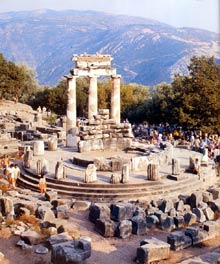
http://www.ecogreece.com/images/archaeological/delphi.jpg
Castalian Fountain at Delphi


  The fountain is also an allusion to Samuel Taylor Coleridge’s dream inspired poem "Kubla Khan":
 
The shadow of the dome of pleasure
Floated midway on the waves;
Where was heard the mingled measure
From the fountain and the caves.
It was a miracle of rare device,
A sunny pleasure-dome with caves of ice!


A damsel with a dulcimer
In a vision once I saw:
It was an Abyssinian maid,
And on her dulcimer she played,
Singing of Mount Abora.
Could I revive within me
Her symphony and song,
To such a deep delight 'twould win me
That with music loud and long
I would build that dome in air,
That sunny dome! those caves of ice!
And all who heard should see them there,
And all should cry, Beware! Beware!
His flashing eyes, his floating hair!
Weave a circle round him thrice,
And close your eyes with holy dread,
For he on honey-dew hath fed
And drunk the milk of Paradise.

            “Kubla Khan” illustrates the power of imagination and art through the medium of a “mighty fountain”.  This fountain feeds the sacred river Alph that runs alongside Kubla’s pleasure dome.  While encountering the fountain, a dream is revived in Kubla Khan of an Abyssinian maid singing of Mount Abora while playing a dulcimer.  The music enraptures Kubla and he muses upon the voice having the strength to raise his “dome in the air.”  The musical entity that he is envisioning may be an inference to Mnemosyne, the Goddess of Memory and the mother of the muses whom Kubla Khan calls to aid him in stimulating his senses to produce the poem from the dream. The mountain, in correlation could be a reference to Mount Parnassus; the source of all poetry and the fountain being the eruption of imagination in the spring of nature.  By calling upon this dream Kubla is capable of fabricating a greater more magical reality by using his imagination.  Kubla Khan's "dome in the air" can therefore be connected to Kinbote and his land of Zembla; both persons who "deliberately peel off a drab and unhappy past and replaces it with a brilliant invention" (238).  It is an act that John Shade associates with the mindset of a poet.       
 
The delusion of the fountain by Shade of the fountain essentially acts as a motif to Shade’s existence as an artistic entity but also acts as a catalyst to connect the characters of Shade, Kinbote or Charles the Beloved, and Gradus harmoniously throughout the text in the mountain-fountain misprint. 

A system of cells interlinked within
Cells interlinked within cells interlinked
Within one stem.  And dreadfully distinct
Against the dark a tall white fountain played

The reference to Mount Parnassus is evident everywhere throughout Pale Fire and is woven throughout Shade, Kinbote, and Gradus' stories.   

'"what were you writing about last night, John?  Your study window was simply blazing"
"Mountains," he answered.
The Bera Range, an erection of veined stone and shappy firs, rose before me in all its power and pride......He calculated that during the last twenty-four hours his brain had put in, roughly, a thousand minutes of work...and would I mind very much if we started to go home-so that he could plunge back into his chaos and drag out of it, with all its wet stars, his cosmos?
How could I say no?  That mountain air had gone to my head: he was reassembling my Zembla!"(260). 

(to be continued..... )

Thursday, November 10, 2011

The Music Palace

                        Pale Fire- unfolds an obscure composition of thoughts and ideas into a perplexing novel.  It has also had the ability to invade my thoughts and awaken a memory of mine that parallels the relationship between Kinbote and Shade.  

Throughout the majority of my childhood my family has acquired a neighbor with frighteningly similar characteristics to Charles Kinbote or V. Botkin.  She has always been extremely friendly but has also suffered from dementia for many years that has been gradually deteriorating her cognitive mind.  My neighbor has had the overwhelming desire to be a member of our family and since the day I have met her she has insisted I refer to her as “Aunty C” and usually describes my family’s house as “our” house.  However, besides a few minor mishaps and annoyances she has never been unpleasant to be around.

            As Professor Sexson illustrated the correlation between the memory palace and Pale Fire in class a specific memory of Aunty C came to light out of the depths of my mind that I have not been capable of ignoring.  During one Christmas holiday, my family received a common phone call from our friendly neighbor Aunty C.  In this specific year Aunty C had the insisted that she was suffering from some incurable disease that she was on the verge of going paralyzed and ultimately this would be the last Christmas of her life.  For this reason, she asked our family if we would be so kind as to come over to her house immediately because she had something important to show us.  My family rushed next door to her chaotically organized house where she explained to us that she would like to show us her Christmas decorations.  We agreed and were swept off onto a two hour long tour of her various trinkets.  She did not have very many of these “treasures” but each one stimulated a mess of memories that she found necessary to share.  At the instant of this experience I was greatly irritated that I had to be objected to this reminiscent journey of Aunty C, now however I realize that this was her own personal memory palace.  Each jewel (a picture frame, a vase, a hairbrush) had a spatial orientation in the room and each object had a relationship with a memory that was interconnected to other memories.  This “method of loci” in latin was a gateway she wished to share of her being.  

            I believe that a similar analogy can be used to illustrate the poem of Pale Fire.  The poem is first and foremost the remembrance of the suicide of Shade’s daughter Hazel.  This memory however is rather than being intertwined with spatial connections is glued together through the continuity of music, Mnemosyne-the mother of the muses.  


And that odd muse of mine,
My versipel, is with me everywhere,
In carrel and in car, and in my chair
(Canto IV Line 946-949)

Music is the being that possesses the unmatchable power to resurrect old remembrances and through these reflections establish new ideas and beliefs.  Einstein for example once stated that music was the driving force behind his intuition and that musical perception was the source of all of his scientific discoveries.  


“If I were not a physicist," he once said, "I would probably be a musician. I often think in music. I live my daydreams in music. I see my life in terms of music.... I get most joy in life out of music" (Calaprice, 2000, 155). 

Music in Pale Fire moves with fluidity through the pages in a similar way. 


A system of cells interlinked within
Cells interlinked within cells interlinked
Within one stem

Canto III: Line 704


            "A stem" can be a reference to a root of a word, the main axis of a plant, but it can also be associated to a line in music notation that connects consecutive note heads.  The multiple definitions of the word “stem” I believe alludes to the arbitrary link connecting nature, art, and language and thus to our memories that can be identified on each page of Pale Fire.
               

Monday, November 7, 2011

Music is Being


For my final project, my goal is to further explore the intrinsic prose of Pale Fire through the means of the myth of Orpheus.   The tale of Orpheus embodies the essence of the soul which conveys Orpheus’ passionate mission to reunite with his fallen love Euydice by descending into the Underworld.  Through the medium of music, Orpheus generates a link between beauty and death that has the power to evoke Pluto to experience empathy and compassion towards the misfortunate Orpheus.   The transmigration of the soul to the underworld by Orpheus was not founded upon the sentiment of fear or duty but from the greater elation and spirit of love.   This and the reciprocal motive of pity are the essence of the Orphic Doctrine that is configured in the metempsychosis cycle. 
These notions are all balanced upon the foundation of music which is in turn the underlying heartbeat pulsing throughout Pale Fire.  Only through the means of esthetic beauty-the brilliance of artistic lyricism, can the soul escape the continuous cycle of metamorphosis and return to its true nature.  Through my project I intend to expound upon the motive of music to uncover the universal harmonies of the cicadas in Nabokov’s Pale Fire and the infinite expanses of the imagination.   
She sang beyond the genius of the sea

Wednesday, November 2, 2011

Echo and Narcissist


Gently the day has passed in a sustained
Low hum of harmony.  The brain is drained
And a brown ament, and the noun I meant
To use but did not, dry on the cement.
Maybe my sensual love for the consonne
D’appui, Echo’s fey child is based upon
A feeling of fantastically planned,
Richly rhymed life.

Canto 4: Line 963-970


            In Ovid’s Metamorphoses Echo is portrayed as a mountain nymph who loved the sound of her own voice.  For this reason, Jove gave her the role of distracting his wife Juno with her chatter while Jove courted the other mountain nymphs.  Inevitably Juno discovered this deception he cursed Echo stating “the tongue that made a fool of me will shortly have shorter use, the voice be brief hereafter.”  With these words, Echo was forevermore doomed to only voice repeated words of another person and nothing more.  One day as Echo was wandering through the woods she happened upon a beautiful hunter named Narcissus and fell madly in love.  Narcissus was the son of the river naiad Liriope and the river-god Cephisus and was foreseen by the seer Tiresias to live to a ripe old age.  However, this was only under the circumstances that he should never know himself.  

            Desperate to interact with her love but not being capable to initiate the conversation Echo awaited patiently for the moment when Narcissus became separated from his companions.  As Narcissus called out “is anybody here?” Echo replied, repeating his words.  This mirror conversation continued until Echo broke out of the woods and flung herself onto him.  Narcissus denied her and retreated calling out “I would die before I give you a chance at me.”  Poor Echo heartbroken still clung to her love of the hunter and pined for him incapable to sleep or eat.  Echo’s body diminished-her bones turned to stone and her voice became the only fragment of her being that continued to exist restricted from the mountains and forever hiding in the woods. 

            Narcissus however continued to deny any creature that threw his or her heart to him.  One day a slighted admirer prayed to the Gods asking, “May Narcissus Love one day, so himself, and not win over the creature whom he loves!”  Nemesis, the Goddess of Vengeance answered the request and as Narcissus quenched his thirst at a pool and gazed at the water he grew lovesick towards his own reflection.  The loved became the lover.  As Narcissus realizes he is drowning in love with his own reflection and turns to death stating “death is not so terrible, since it takes my trouble from me; I am sorry only the boy I love must die: we die together.”  Echo, gazing at the scene feels pity for the star-crossed Narcissus and as Narcissus kills himself with Narcissus’ last word “Alas!” Echo replies.  Echo mourned for Narcissus and when venturing to give him a proper burial found instead of a body a daffodil (the flower that was also collected by Persephone before her abduction into the underworld by Pluto and was further named by the botanist Linnaeus).  In the underworld, Narcissus is forever gazing at his reflection in the river Styx.  


            The pity and compassion felt by Echo towards Narcissus, the vain boy that denies her, is the reflection that the egotistical King Charles the Beloved only feels towards his neglected wife Disa in his dreams.  “These heart rendering dreams transformed the drab prose of his feeling for her into strong and strange poetry, subsiding undulation of which would flash and disturbb him throughout the day (209).  The groaning dreamer percieved the disarray of her soul and was aware that an odious undeserved, humiliating disaster had befallen her” (211).  As the brilliant Mary McCarthy states in her review: 

“Love is the burden of Pale Fire, love and loss. Love is felt as a kind of homesickness, that yearning for union described by Plato, the pining for the other half of a once-whole body, the straining of the soul's black horse to unite with the white. The sense of loss in love, of separation” 

            Pale Fire is never ceasing to amaze me.  In Ashley’s last blog, she identified that in reference to “the idea of 'consonne d'appui, "Presumably Shade would like to have ended the whole poem with a consonne d'appui; if the next line after line 999 reads "I was the shadow of the waxwing slain" it will indeed have that consonne d'appui (the "l" of "slain" rhyming with not just the vowel, but also with the preceding consonant, of "slane")"  To expand on this: by considering that to complete this unfinished poem an“echo” of the last line would be stated,  I believe it emphasizes this notion of love and pity.  Ovid realized that Narcissus was in a delusion of love “what you seek is nowhere, and if you turn away, you will take with you the boy you love.  The vision is only shadow, only reflection, lacking any substance” It is as Mary McCarthy puts it the common pattern binding all mortal men. 

I was the shadow of the waxwing slain”

Tuesday, November 1, 2011

A World of Mirrors


I was the shadow of the waxwing  slain
By feigned remoteness in the windowpane
Canto 1: Lines 131-132

“Today,when the feigned remoteness” has indeed performed its dreadful duty, and the poem we have is the only “shadow” that remains, we cannot help reading into these lines something more than mirrorplay and mirage shimmer.  We feel doom, in the image of Gradus, eating away the miles and miles of “feigned remoteness” between him and poor Shade.  He, too, is to meet, in his urgent and blind flight, a reflection that will shatter him” (135). 

*This “mirror play and mirage shimmer” is a key theme in Pale Fire that Nabokov emphasizes throughout  the novel to illustrate the ambiguity of life and imagination.  A mirror functions by reflecting light and creating an inverted image in its glass of the material image directly ahead of its gaze.  Nabokov plays with this notion beautifully to accentuate the role of art in the universe by intricately and strategically placing the evidence of this device throughout the novel.   The quintessential symbol of the “lemniscate”, the infinity symbol, or “a unicursal bicircular quartic” embodies this action of reflection that is displayed throughout the poem and commentary.  With this aphorism exposed, it is conveyed to bring to light further ideas in Nabokov’s design.  

The reflection of art and nature is exemplified through the following lines in Pale Fire:
 And in the morning, diamonds of frost
Express amazement: Whose spurred feet have crossed
From left to right the blank page of the road?
Reading from left to right in winter’s code:
A dot, an arrow pointing back; repeat:
Dot, arrow pointing back…A pheasant’s feet!
Canto 1: Lines 19-25


The recognized method in Western culture of deciphering and forming art in the written form is through the means of reading the lines from left to right.   The pheasant’s feet on the other hand written on the “blank page of the road” are formed in the poem going the opposite direction, the reflection through “diamonds of frost” into the creation of art.  The “code” expressed in this passage is the fact that art or in this case poetry is the instrument utilized to “make sense” of the winter scene.  

The poem: Shade’s creation of art through his perception of nature proceeded to destroy his rough drafts that were not utilized; “in the pale fire of the incinerator before which he stood with bent head like an official mourner among the wind-borne black butterflies of that backyard auto-da-fé” (15).  This destruction is thus the creation of more beauty in the magical form of “wind borne black butterflies,” with the rejected cards forming art within itself.  This image painted in the forward of the novel communicates the continuous reflection upon another reflection that is represented through the reincarnation of art.  The ouroborus.  

Nabokov enhances this notion of art as a reflection of nature by demonstrating the enigma of language through the word-play that causes further obscurity to his novel.  The clever game of reflection is illustrated through reversals in character and place names such as the Goldsworth house and Wordsmith University that can be altered into a “word’s worth” and “goldsmith.”  This is a significant implication of the scheme that Nabokov may be proposing of the obtuseness of language.  Throughout Pale Fire “odd Gallicism” (Canto 2: Line 455) is encountered throughout the commentary.  What does this ode to the French language mean?  French is a beautiful dialect that has been known to have a strange tendency in its lexicon to possess “double entendres” or double meanings.  Nabokov has produced in Pale Fire a double entendre   as an epithet for the reader to look past the obvious “meaning” of a word and discover the true message.  

For example baiser has a double meaning of “to kiss” and “to have sexual intercourse.”   With this in mind, by having a phrase such as “je lui pris la main et la braise” or I took her by the hand and… (the options could be) kiss her hand, kiss her, or have sexual intercourse with her-the double entendre.  The reader can interpret this phrase in a number of ways with the meaning only depending on how explicit the reader desires it to be.  Through the imagination of the audience Nabokov’s Pale Fire comes to life.  

This thus leads to the question of who killed John Shade?  The truth is that even by completing the the novel, the answer still is a bit uncertain.  Nonetheless the black butterflies may provide a clue.  The minute before Shade’s death, a dark Vanessa flashed in the sunbeams and rested on Shade’s sleeve and quickly dissolves.  The outcome following this event is the deaths of both Shade and Gradus.  Kinbote however states that he will assume other disguises but will continue to exist until the next Gradus appears.  With these final words, it seems as if Gradus, Shade, and Kinbote function as symbols.   It may be that Shade is the creative notion illustrated by the manifestation of the poem, Gradus- the “reality” that bridges itself with art after the poem has been completed (ending or destroying the beauty but also reflecting more beauty through the means of black butterflies) and Kinbote being the imaginative mind.  He can thus do what “only a true artist can do-pounce upon the forgotten butterfly of revelation, wean myself abruptly from the habit of things, see the web of the world, and the warp and the weft of the web” (289).  Through this fantastically complex portrayal of the imaginative process, Kinbote’s character has a tremendous ability to transcend into unlimited shapes and disguises and can interpret any entity (including a poem such as Pale Fire) into a tale of Kings, escapes, and revolutions.  In the world of reflections, the mind has an infinite capacity to create.    

Thursday, October 27, 2011

Homosexuality in Pale Fire


            As Ashley wrote in her blog “nothing is accidental” in Nabokov’s Pale Fire.  With this mindset I explored the topic of homosexuality and found the following lines quite interesting…

Yet, if prior to life we had
Been able to imagine life, what mad,
Impossible, unutterable weird,
Wonderful nonsense it might have appeared!

So why join in the vulgar laughter? Why
Scorn a heareafter none can verify:
The Turk’s delight, the future lyres, the talks
With Socrates and Proust in cypress walks,
-Canto Two-Lines 217-224


            Throughout Pale Fire I believe that there is a great significance placed on the references of trees and that the cypress trees referenced in the lines “the future lyres, the talked with Socrates and Proust in cypress walks” may be alluding to the myths of Orpheus and Cyparissus.


In Greek and Roman mythology the cypress tree has an association with the stories of Orpheus and Cyparissus in the Ancient Roman poet Ovid’s Metamorphoses.  In the tale, Cyparissus is portrayed as a boy who after accidently killing his beloved pet stag with his javelin was turned into a cypress tree to forever mourn for others in their sorrows from his incessant grief. Cyparissus’ unfortunate end is framed within the story of Orpheus.  Orpheus was well known as a legendary poet and musician whom the God Apollo had given a golden lyre as a gift. On one fateful day Orpheus’ wife Eurydice was killed by vipers in an effort to escape from a satyr.  Orpheus immersed with grief then ventured to the underworld to make a deal with Hades to retrieve his wife.  Hades agrees to allow Orpheus to bring back Eurydice under the condition that he must ascend in front of his wife and if he turned is eyes toward her before they reached the light the gift of her delivery would be lost.  Unfortunately Orpheus could not control his anxiety of losing Eurydice again and averted his gaze towards her causing Eurydice died a second time.  In his despair of his loss “Orpheus had abstained from the love of women, either because things ended badly for him, or because he had sworn to do so. Yet, many felt a desire to be joined with the poet, and many grieved at rejection. Indeed, he was the first of the Thracian people to transfer his love to young boys, and enjoy their brief springtime, and early flowering, this side of manhood” Orpheus subsequently begins playing his lyre and the cypress of the once Cyparissus sways to Orpheus’ beautiful remorseful music.
            This hidden reference to homosexuality is accompanied by the references to Socrates and Proust; both of whom have had their sexual orientation questioned with Proust being known as one of the first European novelist to mention homosexuality openly in literature. 
            I believe that this reference to homosexuality is another piece of evidence to the web that is interlaced between the poem by John Shade, the commentary of Charles Kinbote, and the story of the former King of Zembla Charles the Beloved.  In the preface, Charles Kinbote is portrayed by a group of drama students at the University as “a pompous women hater with a German accent, constantly quoting Housman and nibbling raw carrots” (25).  There is also attention given to a few of Kinbote’s male lovers throughout the commentary.  Charles the Beloved is also depicted as having a flame with his childhood friend Oleg who were illustrated as "in a manly state and moaning like doves" (127) after locking themselves up in Charles' room and sharing his bed. 
            It is clear through the allusions that are twisted within Pale Fire that Nabokov is playing a mind game of chess with his audience.  However in his game, if the reader does not play by his rules he or she will potentially miss the point of the novel.  Kinbote states that “today, when the "feigned remoteness" has indeed performed its dreadful duty, and the poem we have is the only “shadow” that remains, we cannot help reading into these lines something more than mirrorplay and mirage shimmer” (135).  By climbing the ladder of comprehension the story continues to create a shadow in our minds that manifest countless questions but by following Nabokov’s instructions and “reading into these lines” a greater meaning can be achieved.